
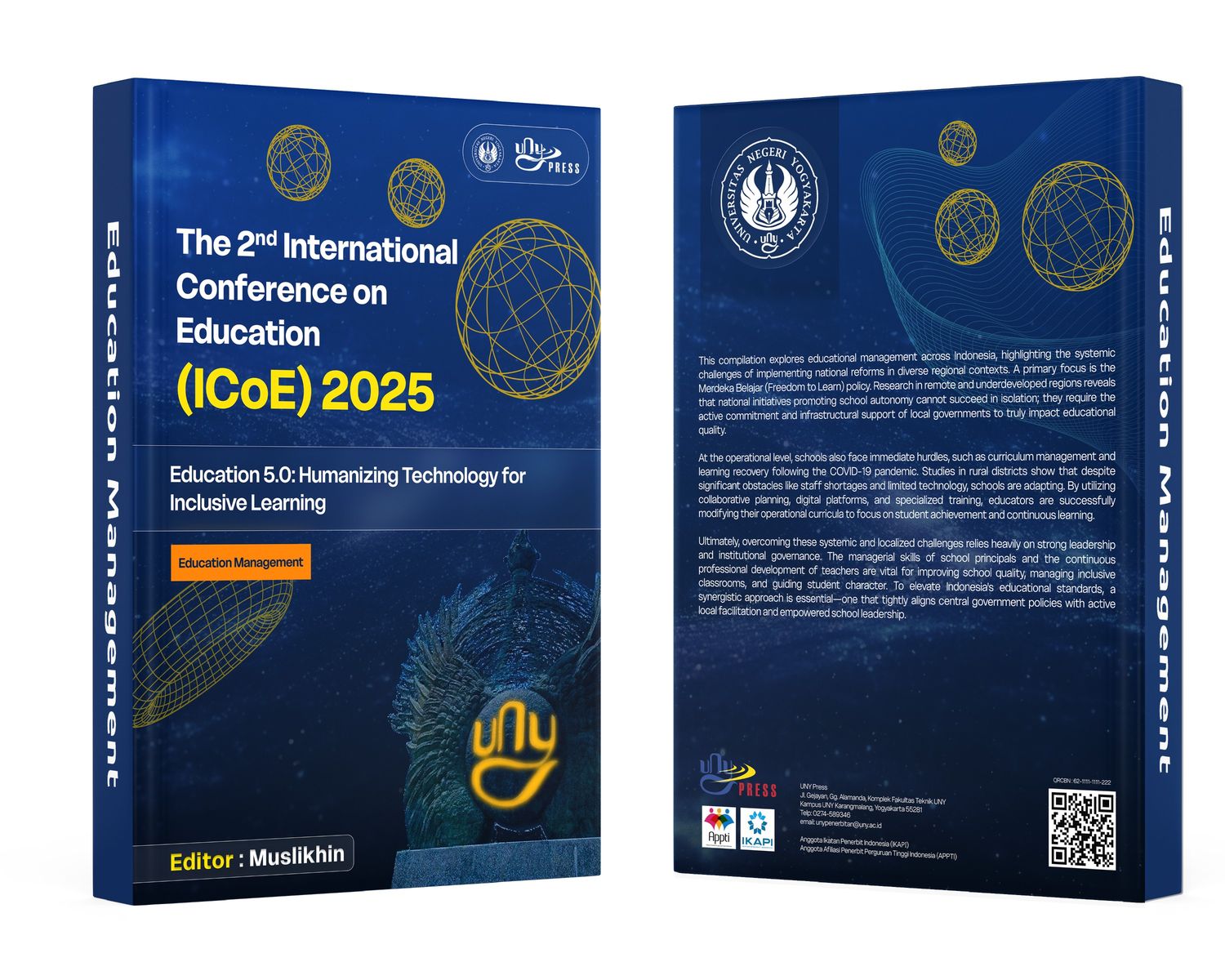
PROCEEDINGS The Second International Conference on Education (ICoE) 2025 Education 5.0: Humanizing Technology for Inclusive Learning: Education Management
Penulis:
Steering Committee: Prof. Nur Hidayanto Pancoro Setyo Putro, Ph.D. Organizing Committee: Prof. Dr. Guntur, M.Pd.; Editor Muslikhin
ISBN:
--
Harga:
200.000
SINOPSIS:
This document presents a comprehensive exploration of educational management across Indonesia, shedding light on the intricate challenges and strategic solutions involved in elevating the nation's educational standards. At its core, the compilation examines the multifaceted reality of implementing national education policies, improving teacher competencies, and managing school infrastructure within diverse and often resource-limited regional contexts.
A primary focus of the research is the impact of national initiatives, specifically the Merdeka Belajar (Freedom to Learn) policy, in marginalized areas. When looking at frontier, outermost, and underdeveloped (3T) regions such as North Kalimantan, the studies reveal that national reforms promoting school autonomy and flexible curricula are not enough on their own. The direct impact of these policies on educational quality remains limited without the active commitment and capacity of local governments. This local support acts as a crucial bridge, highlighting that equitable infrastructure and targeted capacity building for teachers are absolute prerequisites for national policies to succeed in remote areas.
Beyond national policy, schools face immediate operational challenges, particularly concerning curriculum management and learning recovery following the severe disruptions of the COVID-19 pandemic. Research conducted in rural primary schools within the Borobudur district illustrates these ground-level hurdles. To effectively manage the Education Unit Operational Curriculum (KOSP) and drive learning recovery, schools must rely on collaborative planning and evaluations centered on student achievement. Despite facing significant obstacles like a shortage of permanent teaching staff and limited technological capabilities, these schools have demonstrated resilience by utilizing digital platforms, communication forums, and specialized training to support educational recovery.
The success of both national policies and localized curriculum efforts ultimately rests on strong leadership, teacher competency, and institutional governance. Effective educational management is heavily dependent on the managerial and supervisory skills of school principals, who play a direct role in improving school quality, motivating staff, and overseeing curriculum implementation. Furthermore, continuous professional development is essential for educators, particularly in managing inclusive classrooms where specialized training significantly enhances teaching practices and student engagement. Alongside human resource management, schools are also developing robust institutional governance strategies to proactively address student delinquency through character development and to implement healthy school programs.
Ultimately, this compilation underscores that elevating the standard of education in Indonesia requires a deeply synergistic approach. Successful educational management cannot happen in silos; it demands the alignment of visionary central government policies with active, supportive local government facilitation. When this structural alignment is combined with empowered school leadership and continuously improving teacher capabilities, educational institutions are far better equipped to navigate the complexities of modern educational demands and achieve truly equitable learning outcomes across the nation.
Kategori: